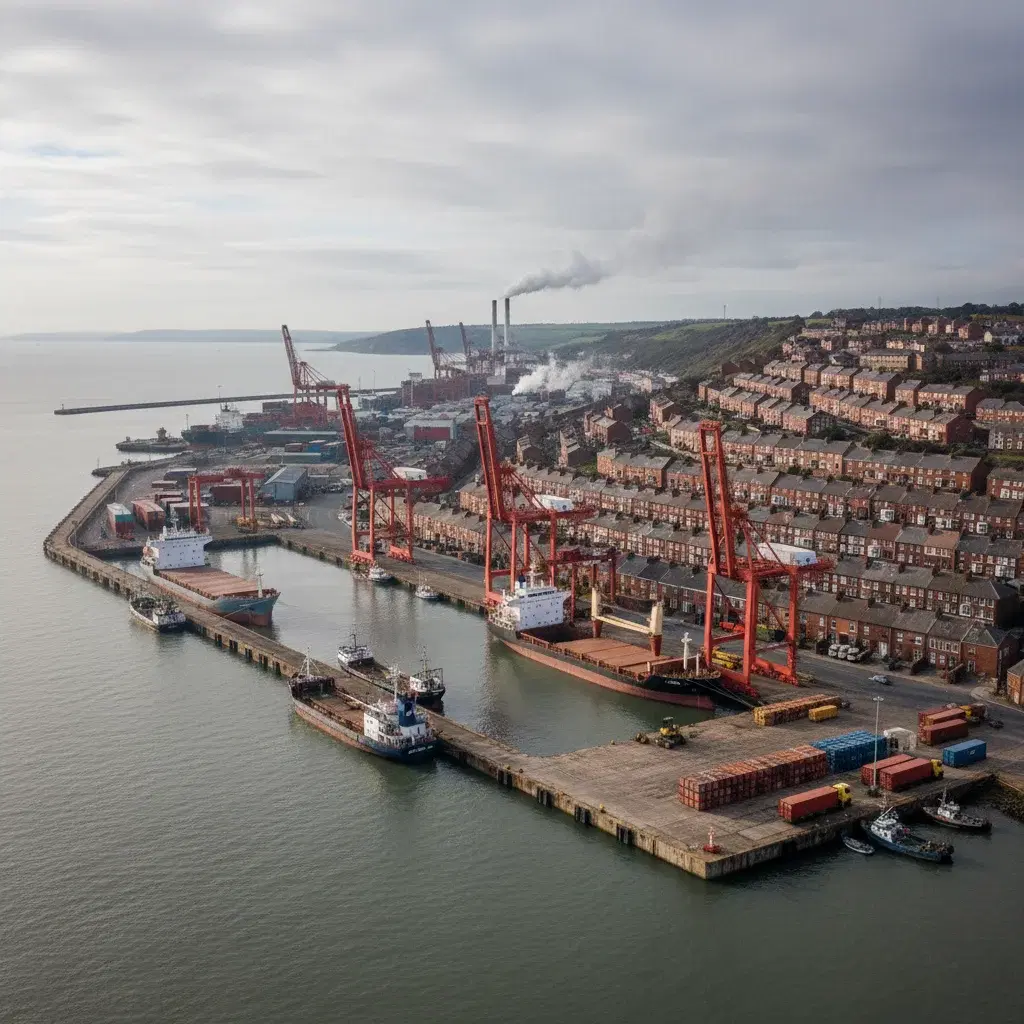
History of Blyth
From a medieval salt port to Europe's largest coal exporter, through shipbuilding, two world wars, and the closure of the pits -- the story of Blyth, Northumberland.
Blyth sits at the mouth of the River Blyth on the Northumberland coast, a town shaped almost entirely by what lay beneath it and what sailed from its harbour. Its story runs from medieval monks exporting salt, through centuries of coal, a shipbuilding industry that produced the Royal Navy's first seaplane carrier, two world wars, the painful end of mining, and a modern reinvention built on clean energy and a new railway. It is a story of graft, resilience, and reinvention.
Medieval Origins
The earliest recorded reference to the area dates to 1208, when it appears as "Snoc de Blimue" -- the snook at the mouth of the River Blyth. Before there was a town, there were monks. The Tynemouth Priory held lands around the estuary, and from the twelfth century they were exporting salt, produced by boiling seawater in pans along the coast. The sheltered river mouth provided a natural harbour for small trading vessels, and a modest fishing settlement grew alongside it.
For centuries, Blyth remained small -- a place of fishing boats, salt pans, and coastal trade serving the agricultural hinterland. The ancient townships of Cowpen and South Blyth formed the core of what would eventually become the modern town.
The Coal Trade Takes Hold
Small-scale coal mining had taken place around Cowpen and Bebside since the medieval period, but the trade grew significantly from the sixteenth century. By the close of the 1500s, coal mines were recorded at Cowpen and Bebside, and in 1609, during the reign of James I, some 21,571 tons of coal were shipped from Blyth -- a substantial quantity that steadily replaced the declining salt trade.
The construction of a major commercial quay in 1682 transformed the harbour. Coaling quays, a pilots' watch house, and a lighthouse followed during the early eighteenth century. In 1788, the first coal staith was built -- a raised timber structure that allowed wagons to tip their loads directly into the holds of ships below. It was a simple but transformative piece of engineering.
Best for: In 1609, over 21,000 tons of coal were shipped from Blyth. By the twentieth century, that figure would reach six million tons a year.
Railway, Shipbuilding, and Boom
The arrival of the railway changed everything. The Blyth and Tyne Railway, developed from the 1840s, connected the collieries of south-east Northumberland directly to the port. Coal shipments grew rapidly, and new staithes were built to handle the ever-increasing flow.
Shipbuilding began on the south bank of the river in 1748, with large-scale operations starting from 1811. In 1883, the Blyth Shipbuilding and Dry Docks Company was formally established, building cargo liners, tramp steamers, and colliers. At its peak, the yard had five dry docks and four building slipways, making it one of the largest on the North East coast. In 1914, a cargo ship under construction at the yard was purchased by the Admiralty and converted into HMS Ark Royal -- the Royal Navy's first purpose-built seaplane carrier, which would serve at Gallipoli.
By 1930, the port was exporting 5.5 million tons of coal annually, and Blyth had grown from a coastal village into one of the most industrially significant towns in Northumberland. Terraced streets housed thousands of families whose livelihoods depended on the port, the mines, and the shipyard.
Best for: HMS Ark Royal, the Royal Navy's first seaplane carrier, was built at Blyth's shipyard in 1914 and served during the Gallipoli campaign.
Two World Wars
Both world wars drew heavily on Blyth's industrial capacity and strategic position. During the First World War, the shipyard turned to military production, building minesweepers, landing craft, and sloops for the Admiralty. The Blyth Battery was constructed on the Links in 1916 to defend the harbour from German naval attack.
In the Second World War, the harbour became home to the Sixth Submarine Flotilla -- one of the most secretive naval installations in Britain. The Battery was reactivated, the shipyard built warships, and the port played a vital role in coastal convoy protection. The town did not escape unscathed: in April 1941, German bombing raids caused severe damage, including a direct hit on the signal box.
The End of Mining
The second half of the twentieth century brought a slow, painful contraction. The collieries that had fed the port began to close: North Seaton in 1961, Horton Grange at Bebside in 1962, the Isabella Pit in 1966, and Mill Pit and Cambois in 1968. The last pit standing, Bates Colliery, closed in 1986.
With the mines went the coal trade, and with it the staithes, the wagons, and thousands of jobs. The shipyard had already closed in 1967 after years of losses. Blyth, like many industrial towns across the North East, faced a difficult period of high unemployment and economic uncertainty.
Best for: Blyth's last colliery, Bates Pit, closed in 1986. At one time the town had six working collieries within its boundaries.
Regeneration and the Future
The turnaround began with the port's reinvention. In 2000, the UK's first offshore wind farm was commissioned off the Blyth coast -- a pioneering moment in British energy history. The Port of Blyth repositioned itself as an offshore energy support base, and in 2021 the Bates Clean Energy Terminal opened on the site of the old Bates Colliery -- clean energy on the ground where coal was once mined.
A 90-million-pound regeneration programme is transforming the town centre, funded by the Government's Future High Street Fund, Town Deal, and Levelling Up investment. The Northumberland Line has brought passenger rail services back, with stations at Newsham and Blyth Bebside connecting the town to Newcastle for the first time in decades.
The Spirit of the Staithes sculpture stands on the quayside -- thirteen steel beams that, from the right angle, become a life-size steam train. It is a fitting memorial: Blyth remembers where it came from, even as it builds something new.
More on Blyth's heritage: read our guides to the history of Blyth Port, the submarine base, the Blyth Battery, and Blyth's coal heritage. Browse the local directory or check what's on this week.
Know something we've missed? Get in touch and we'll add it.